systemd-sysext in Production
What We Learned Extending /usr Without a Package Manager
Brian "bex" Exelbierd ·
[email protected]Principal Product Manager, Microsoft Azure
Upstream Linux
Daniel Zaťovič ·
[email protected]Software Engineer, Microsoft Azure
Flatcar Engineering
DevConf.CZ · June 18, 2026 · Brno

I’ve got 99 problems
and they’re all packaging
- Jay-Z in his Linux Admin Days
… and now there are 15 standards

Agenda
- Why we needed sysext
- What sysext actually is
- How Flatcar ships it in production
- Live demo
- What broke, what we fixed
- What we ship
- When to reach for sysext
- Try it today
We built an immutable OS — on purpose
Flatcar (and CoreOS before it) made a design decision: the OS image is a signed and read-only.
/usr is immutable and dm-verity protected- no package manager on the host
- every node in the fleet is bit-identical, reproducible and defined at provisioning
- avoids configuration drift
- updates are atomic A/B — whole-image, auto-rollback, no half-patched states
- single-purpose OS - provide just enough to run containers
You can’t tweak the OS in place, it’s a value proposition not a bug.
… but we still needed to change some parts on the fly
The one part of the OS users most need to control is the container runtime.
- the most common exmple is contaner runtime
- “Pin Docker to a specific version and hold it there while the OS keeps updating”
- “Run one Docker version on these nodes, a different one on those”
- “We don’t want Docker at all — ship containerd only”
- “We need podman / a newer runc / a different container runtime”
- ship GPU specific drivers and container runtimes for GPU workloads
A frozen /usr can’t do any of that.
Our first answer: Torcx
Torcx — a boot-time addon manager (CoreOS heritage) that let you pick your Docker / containerd / runc.
- At build time, the real binaries were replaced with symlinks to nowhere
- At boot, the Torcx image was fetched, unpacked, and the symlinks were rewired — magic
- Non-standard paths → couldn’t reuse upstream Gentoo ebuilds; invasive build-time hooks
- Updating meant a manifest change → re-provision or in-place edits → config drift
- Images were frozen after build — you couldn’t add or modify one
Bespoke, brittle, and worse Flatcar-only. We get to build it … alone … forever.
So we adopted a standard: sysext
Instead of maintaining more bespoke tooling, we moved to a systemd primitive the whole ecosystem shares.
“System extension images may — dynamically at runtime — extend the /usr/ and /opt/ directory hierarchies with additional files. This is particularly useful on immutable system images where a /usr/ and/or /opt/ hierarchy residing on a read-only file system shall be extended temporarily at runtime without making any persistent modifications.”
— systemd-sysext(8) man page
If you have a modern systemd, you already have this. It is not a Flatcar only feature, Flatcar is just one of the distros that took the bet early.
The mechanics in 30 seconds

A directory, FS image or DDI with /usr/lib/extension-release.d/extension-release.<SYSEXT NAME>:
ID=flatcar           # target OS — must match host's ID (or _any)
ARCHITECTURE=x86-64  # must match uname (or _any)

# pick ONE version-matching key:
VERSION_ID=4628.1.0  # pin to one OS release (can link host /usr)
SYSEXT_LEVEL=1.0     # instead of using specific OS version use sysext level
systemd merges only when these match the host. systemd-sysext merge | unmerge | refresh.
What sysext is NOT
“System extension images should not be misunderstood as a generic software packaging framework, as no dependency scheme is available: system extensions should carry all files they need themselves, except for those already shipped in the underlying host system image.”
— systemd-sysext(8) man page
- No dependency resolution — author owns the dep closure
- No scriptlets /
%post / triggers — pure file overlay only
- Hierarchy locked to
/usr + /opt — files elsewhere are silently ignored
- Additive by spec — collision detection is not enforced
If you need any of those, sysext is the wrong tool.
OS-dependent vs independent sysexts
### `ID=flatcar` + `VERSION_ID`
*"I move when the OS moves."*
- Pinned to a specific Flatcar release
- Can dynamic-link against host `/usr`
- Won't load after an OS update — rebuilt each release
- **Use for**: OEM agents, drivers
### `ID=_any`
*"I run on any OS."*
- No version coupling — matches any host, any release
- Must bundle everything (static, or libs in `/usr/local/
/`)
- Updates on its own clock via `systemd-sysupdate`
- **Use for**: tools with separate life cycles, distro-agnostic tools
</div>
</div>
---
# Demo
## Kubernetes-as-a-sysext
---
# Issue with self-contained sysexts
- **Nothing you can count on**
- **No dependency resolution** — no package manager, if you need a library you have to bring it
- **You vendor each dependency by hand** — walk the link tree and copy every missing library into the sysext:
```
ldd /usr/bin/
libfoo.so.1 => not found ← you must bring this
libbar.so.2 => not found ← and this
libc.so.6 => /usr/lib/... ← already in base /usr, OK
```
- **It's recursive** — dependencies have dependencies, so re-run `ldd` on everything you copy
- **Collisions are a secondary risk** — if two sysexts ship the same `libfoo.so.1`, first merge wins and overlayfs won't warn you.
---
# Our answer to this
Two tools in `flatcar/sysext-bakery`, both making a sysext self-contained:
- **Flix** — rewrite ELF binaries with `patchelf` so each only looks in its own private dir
- `patchelf --set-interpreter /usr/local//ld-linux --no-default-lib --set-rpath /usr/local/ /usr/bin/`
- No host-library coupling — the binary can't pick up a colliding `libfoo.so`
- **Flatwrap** — ship the whole rootfs under `/usr/local//`, wrap the entry point in a mount namespace
- `unshare -m` → `mount --bind /usr/local//usr …` → `chroot`
- Each invocation runs in its own private view of `/usr`
Note: Today we have ship most of our sysexts either built directly against the distro during release or as independent **static binary** sysexts. This partly because the cloud-native world is Go and Rust, and partly because most of the non-static use cases have warranted including in our release pipeline. However, we do ship `tilde` (Flix) and `btop` (Flatwrap) using these tools, partly as proofs of concept.
---
# Next problem we hit: confext/sysext was strictly read-only
Read-only is great, right up until it isn't.
Some use cases that needed a writable upper layer:
- We wanted to use confext for managing `/etc` and most things expect to be able to write `/etc`
- Using sysexts on a mutable system sets `/usr` to read-only
So we drove a fix **upstream** landing a spec change for mutable mode which shipped in **systemd v256** (June 2024).
---
# What we ship today
In Stable- Three categories of Flatcar sysexts
- **Opt-out** — shipped *in the base image*, on by default
- `docker-flatcar` · `containerd-flatcar` · `oem-*`
- **Opt-in** — built by Flatcar CI, **downloaded at provisioning**, off by default
- `nvidia-drivers-*` · `zfs` · `python` · `podman` · `incus`
- Enable with one line: `echo nvidia-drivers >> /etc/flatcar/enabled-sysext.conf`
Opt-out and opt-in are **OS-dependent**: `ID=flatcar` + `VERSION_ID`, signed with the image's ephemeral build key.
- **Community** — from the sysext-bakery, community-built and *not* Flatcar-tested
- `kubernetes` · `k3s` · `cilium` · `nerdctl` · `tailscale` · …28 recipes
- `ID=_any`, self-contained; updates **independently** via `systemd-sysupdate`
- To enforce signatures, **import the bakery key yourself** — it isn't in the image
---
# What we ship also today
In Beta (now rolling into Stable):
- **Confext** — `/etc` is now a `systemd-confext` in a mutable-mode (replaced our custom overlayfs scripts)
- **Sysexts cryptographically signed** — dm-verity roothash signatures, ephemeral build key
- **Format change** — squashfs → **erofs DDI** (Discoverable Disk Image)
This is list is all just tooling around sysext for our users, not the implementation itself.
---
# The two-axis test
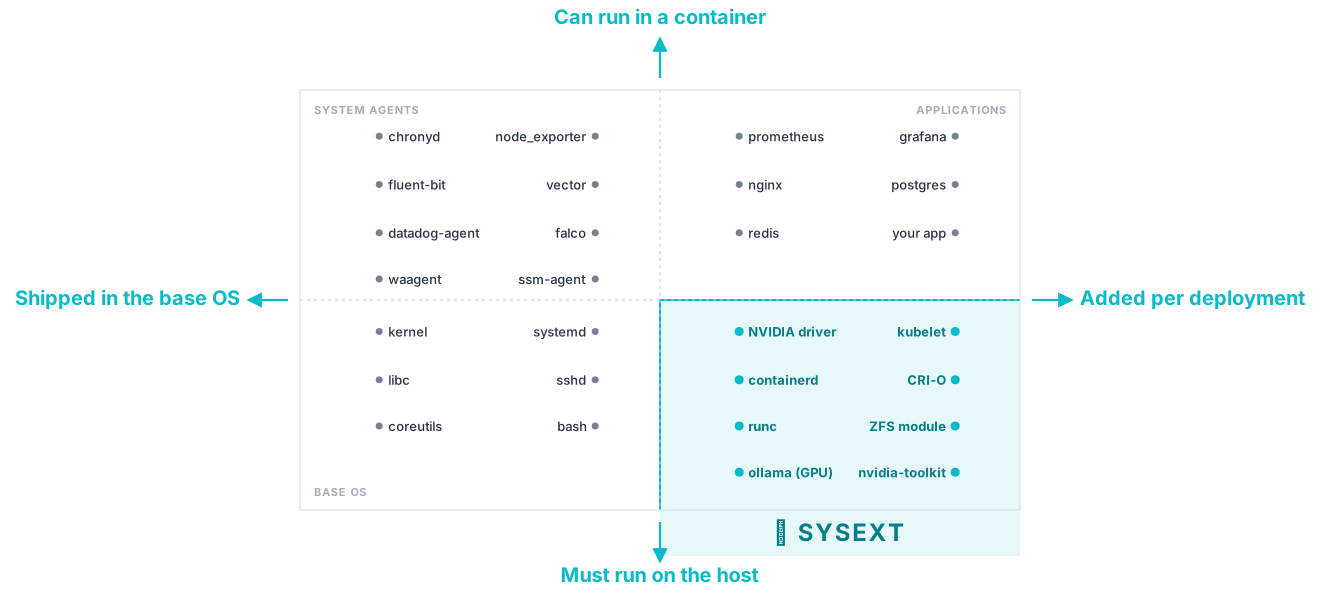
**The sysext quadrant** — needs the host, but is too opinionated to ship with it.
---
# Comparing rpm-ostree, bootc, and sysext
**rpm-ostree** - "I want to add a distribution component"
- Full distro dependency graph; rollback by deployment swap; cadence tied to the base
- rpm-ostree layers **at runtime/on-host, per host** then reboot
**bootc** - "I want to rebuild my entire system on changes"
- Full distro dependency graph; rollback by deployment swap; cadence tied to the base
- bootc bakes **at build time**, ships an OCI image then reboot
**systemd-sysext** - "I want a self-contained add-on with a separate lifecycle and no reboot"
- **No dependency resolution** — a `.raw` tree overlaid on `/usr`; you bundle deps
- `merge` / `unmerge`; cadence **independent** per extension no reboot
---
# Demo
## ... but wait, there's more.
---
# Try it today - Thank you
### Resources
- **flatcar.org** — website & docs
- **extensions.flatcar.org** — sysext bakery
- **Discord** — `discord.gg/PMYjFUsJyq`
- **Chat** — Matrix · CNCF Slack `#flatcar`
- **Office Hours** — every 2nd Tue, 15:30 UTC
### Try it locally
```sh
# clone flatcar/sysext-bakery, then:
./bakery.sh list
./bakery.sh boot kubernetes
# SSH into the VM:
systemctl status kubelet
```
**Lennart's vision**: [0pointer.net/blog/fitting-everything-together.html](https://0pointer.net/blog/fitting-everything-together.html)
**UAPI extension-image spec**: [uapi-group.org/specifications/specs/extension_image](https://uapi-group.org/specifications/specs/extension_image)
**FCOS sysexts**: [github.com/travier/fedora-sysexts](https://github.com/travier/fedora-sysexts)
Brian "bex" Exelbierd ·
[email protected]Principal Product Manager, Microsoft Azure
Upstream Linux
Daniel Zaťovič ·
[email protected]Software Engineer, Microsoft Azure
Flatcar Engineering
---